
Summarize this blog post with:
Quick Summary
A bulk SMS campaign sends one message to many contacts at once, and it performs best when your CRM decides who gets it. This guide shows B2B SaaS teams how to plan, segment, write, send and measure bulk texts, with six campaign scenarios you can adapt. The last sections cover US sending rules and what to look for in a bulk SMS campaign tool before you commit.
Your customer success lead needs 600 customers to know about Saturday’s maintenance window. Your growth marketer needs 140 trial users on day 10 to book an onboarding call. Both are bulk SMS campaigns, yet the second one fails the moment it goes to everyone on the list.
That gap is where B2B text programs lose replies and pick up opt-outs. The fix is not sending fewer texts. It is letting CRM data decide who gets which message, and when.
You have seen those all-caps, generic text messages that scream “BIG SALE TODAY!” or “Limited Offer Buy Now!” You deleted them without a second thought.
That’s the harsh truth of modern SMS marketing.
While bulk SMS campaigns are among the most powerful digital marketing tools, boasting very high open rates and up to 45% conversion potential, too many brands are still stuck in the era of mass messaging.
In this guide, we will walk you through exactly how to do that, from audience segmentation and personalization tactics to automation and analytics, so your next bulk SMS campaign actually drives results, and you will Master SMS Marketing.
Let’s begin now!
Bulk SMS vs. Targeted SMS: What is the Difference, and Which Should You Send?
Bulk SMS optimizes for reach: one message, one list, one send time. Targeted SMS optimizes for relevance: the CRM filters the list and fills each message with details that match the contact’s situation. Most teams need both, and the choice comes down to one question: would the message change if you knew more about the recipient?
Use this rule of thumb when a campaign request lands on your desk:
- If the message reads the same for every contact, send it as bulk SMS.
- If it would change with stage, dates or product usage, target it.
- If you are unsure, start with a broad CRM segment and narrow it after the first send.
Why Personalizing Bulk SMS Campaigns Is the Secret to Standing Out?
A bulk SMS campaign is one message sent to a list of contacts in a single send, with merge fields that insert each recipient’s name or account details. In B2B SaaS, the list comes from a CRM view: all customers on a plan, all registrants for an event, all accounts in one region. One message to the whole list is the right call when every recipient needs the same facts at the same moment:
- Planned maintenance or downtime windows
- Incident and outage updates for affected accounts
- Terms of service, pricing, or policy changes that require notice
- Office closures or changes to support hours
If the message would change based on a contact’s stage, behaviour, or deadline, it belongs in a targeted campaign instead.
The following are the 3 best reasons why Personalizing bulk SMS campaigns is the secret to standing out:-
1) The Problem with Generic SMS Campaigns
Let’s face it: your customers are bombarded with marketing messages daily from emails and push notifications to social ads and text alerts. Generic SMS campaigns, the kind that go out to everyone with the same message, blend into that noise.
Imagine receiving:
“SALE TODAY — 50% OFF EVERYTHING!”
Now imagine instead:
“Hey Priya, your favorite skincare products are 50% off today. Offer valid until 6 p.m.”
Which one feels more relevant? Which one would you respond to? That’s the power of personalization.
A generic SMS may reach thousands, but it doesn’t speak to anyone. Personalized texts, however, make customers feel recognized and valued, and that drives action. This text leads to improve customer relation.
2) The Power of Personalization in SMS Marketing
There is a psychological basis for why personalization and SMS targeting work. Humans crave recognition. When customers see their name or receive a message based on their behavior, they instantly perceive it as more relevant. Think of it as digital empathy; you’re showing that your brand understands them.
Example:
A retail chain ran two versions of a bulk SMS campaign.
- Version A: “Flash Sale Today: 20% Off All Items.”
- Version B: “Hey Sarah, we noticed you love our summer dresses. Get 20% off your favorite collection today!”
Version B outperformed by 38% in click-throughs and 21% in sales conversions. That’s the impact of speaking to individuals, not inboxes.
3) Engagement Is Everything
At its core, personalization is about engagement. You can send 10,000 messages, but if no one opens, reads, or clicks, you’ve achieved nothing. Personalized bulk SMS campaigns create micro-moments of relevance. They grab attention, hold it, and prompt action.
The brands that win with SMS marketing are not the ones shouting the loudest; they are the ones speaking directly to what their audience cares about most.
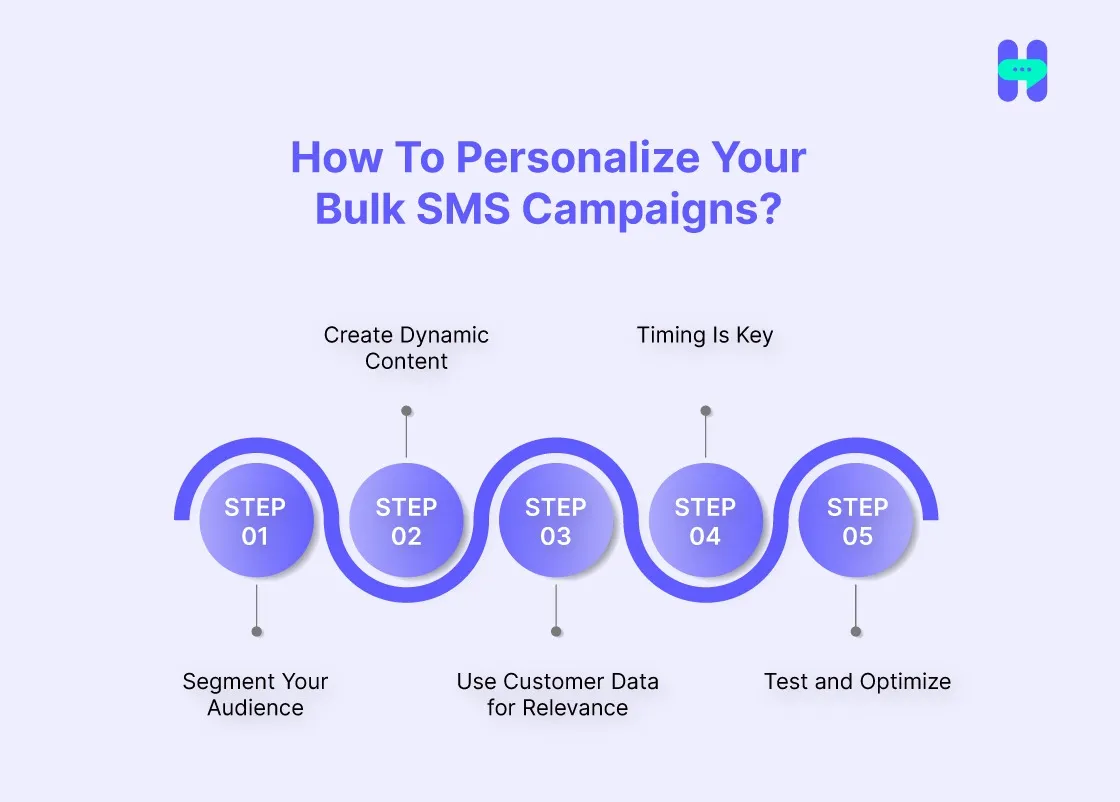
How To Personalize Your Bulk SMS Campaigns?
Now let's make it practical. Here's exactly how to use SMS blast software to turn your bulk SMS campaigns from generic blasts into high-performing, personalized customer experiences.
Step 1: Segment Your Audience
Segmentation is the foundation of personalization. You can not tailor your message if you are talking to everyone the same way.
Segment your audience based on:
- Demographics: age, gender, or location.
- Purchase behavior: frequent buyers, cart abandoners, and first-time customers.
- Engagement level: comparing highly active users to dormant users.
- Interests or preferences: product categories, event attendance, or service usage.
Step 2: Create Dynamic Content
Dynamic content allows you to personalize messages automatically. This is one of the most effective customer engagement strategies. You can use merge tags like [First Name], [Last Order], or [Location] to craft messages that feel individual.
Example:
“Hi [First Name], we’ve restocked your favorite [Product]. Grab it now with 10% off before [Date]!”
These small touches make your messages feel human — not robotic.
Step 3: Use Customer Data for Relevance
Go beyond names. Use behavioral and contextual data to send offers that are relevant and meaningful.
For instance:
- A café can message, “Good morning, Emma! Start your day with 20% off your favorite cappuccino before 10 a.m.”
- A fitness brand can text, “Congrats, Alex! You’ve hit 10 workouts this month. Enjoy a free protein shake on us!”
That’s not marketing, that’s relationship-building.
Step 4: Timing Is Key
Even the best message fails if it’s sent at the wrong time.
According to SMS marketing benchmarks, messages sent between 10 a.m. and 1 p.m. see the highest response rates. Avoid late nights and early mornings.
Utilize automation to tailor the timing and send personalized renewal reminders, birthday wishes, or abandoned cart nudges at the exact moment.
Step 5: Test and Optimize
Personalization isn’t a “set it and forget it” task. Continuously test:
- Subject lines or message openers
- Call-to-action phrasing
- Sending times
- Incentive types (e.g., discounts vs. loyalty points)
HelloSend: All-In-One Tool To Send Bulk SMS
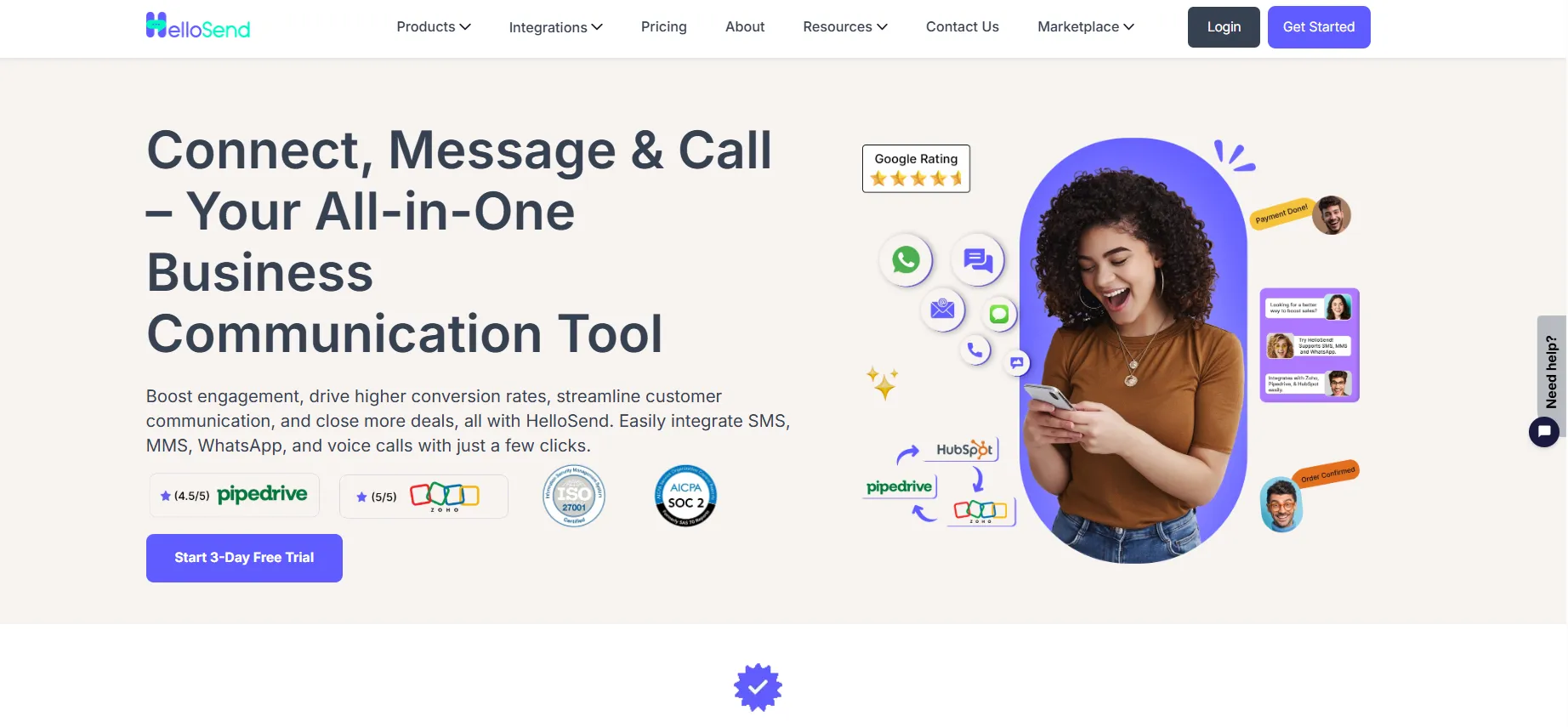
HelloSend stands out for its intuitive dashboard, automation workflows, and affordable pricing. It’s ideal for both small businesses and enterprises that need to run high-volume, personalized bulk SMS campaign without the complexity.
Top Features
Integration with CRM
HelloSend seamlessly integrates with popular CRM systems, including Zoho CRM, Pipedrive, Zendesk, Microsoft Teams, and HubSpot. This integration allows you to send SMS messages directly from your CRM.
To know more about it, visit: HelloSend Integrations
How much does HelloSend costs for bulk SMS campaigns?
HelloSend prices by users, and every plan shares one monthly message pool that any user on the team can draw from. Unused credits roll over to the next month, so a quiet month doesn’t waste what you paid for. Smaller teams can start on a 1-user plan at $45/month or a 2-user plan at $60/month.
Standard plan (3 users included)
Each user beyond the first three costs $25. Adding users also grows the shared message pool:
A five-person team sharing 16,000 messages can send a 2,000-contact maintenance notice and four targeted campaigns of 500 contacts each, all single-segment texts, and use less than half its monthly pool.
The Standard plan includes everything a bulk SMS program needs:
- Campaign messaging across SMS and WhatsApp
- Unlimited message templates for merge-field campaigns
- Up to 300 CRM automations per account
- A centralized inbox for SMS, WhatsApp and WhatsApp Business API replies
- Built-in opt-in and opt-out management for compliance
- Role-based access so each team sees and sends what it should
- Unlimited inbound calls and 300 outbound calls per user per month
Best Practices For Effective Bulk SMS Campaigns
1. Clear Messaging
Keep your message short, focused, and easy to understand. Avoid jargon or long sentences. Your SMS should deliver value immediately, highlighting what’s in it for the reader. Clear, concise communication increases response rates and strengthens brand credibility.
2. Strong CTA
Every SMS should drive one clear action. Use direct, compelling language such as “Shop Now,” “Book Today,” or “Claim Offer.” A strong CTA guides your audience toward the next step, boosting conversions and reducing confusion or hesitation.
3. Legal Compliance
Always get explicit consent before sending messages. Follow local regulations, such as GDPR or TCPA, and include opt-out options, like “Reply STOP to unsubscribe.” Compliance builds trust, prevents fines, and ensures your bulk SMS campaigns remain credible and ethical.
4. Smart Timing
Timing is everything in bulk SMS marketing campaigns. Send texts when your audience is most active, typically between 10 a.m. and 1 p.m. Avoid late nights or early mornings. Timely delivery ensures better visibility, engagement, and customer response. Also, using SMS marketing platforms will be beneficial.
5. Audience Segmentation
Not all customers are the same. Segment your audience based on demographics, interests, or past behavior. Tailored messaging makes your bulk SMS campaigns more relevant, increasing engagement and conversions while reducing unsubscribe rates through more personalized communication.
Conclusion
A text with your customer’s name on it is nice. A text that knows their renewal is next week, or that they haven’t logged in since Tuesday, gets a reply. That’s what personalization buys you: not a warmer tone, but a reason for someone to answer.
Use the customer data you already have, and people start to trust that a message from you is worth opening. That trust builds slowly and breaks fast. One irrelevant blast can undo months of it.
It doesn’t matter whether you sell sneakers, fix air conditioners, or run a SaaS platform.
Send less. Make each message count.
And if you want help setting that up, Start your free 3-day HelloSend trial
FAQs
1. What is a bulk SMS campaign?
A bulk SMS campaign sends one text message to many contacts in a single send. Merge fields can add each recipient’s name or account details. Businesses use bulk SMS for news every contact needs at the same time, such as maintenance windows, outage updates, and policy changes.
2. How do I run a bulk SMS campaign?
- Choose one goal for the campaign.
- Build your list from contacts who gave SMS consent, filtered in your CRM, or imported as a CSV.
- Write a message under 160 characters with your brand name and “Reply STOP to opt out.”
- Send a test to yourself, then schedule the campaign for 8 a.m. to 9 p.m. in the recipient’s local time.
- Track deliveries and replies.
3. What is the difference between bulk SMS and targeted SMS?
Bulk SMS sends the same message to a whole list. Targeted SMS uses CRM data, such as trial stage, renewal date, or last login, to send each group a message that fits its situation. Use bulk SMS for announcements everyone needs and targeted SMS when the message would change based on who receives it.
4. Is bulk SMS legal, and what consent do I need?
Bulk SMS is legal in the US when you have the right consent and follow carrier rules:
- Marketing texts need prior express written consent under the TCPA.
- Informational texts, such as account alerts, need the contact’s prior consent to be texted.
- Every campaign must honor STOP requests and send between 8 a.m. and 9 p.m. in the recipient’s local time (8 p.m. in states such as Florida).
- Business numbers need 10DLC registration to send texts from a standard 10-digit number.
5. How can I measure the success of my bulk SMS campaigns?
Measure bulk SMS success against the business results the campaign was meant to drive, such as meetings booked, renewals closed, or support tickets avoided. Along the way, track:
- delivery and failure rates
- opt-out rate
- reply rate
- clicks on tracked links
Compare results by audience segment, not just campaign totals, to see which groups respond and when.